
Background
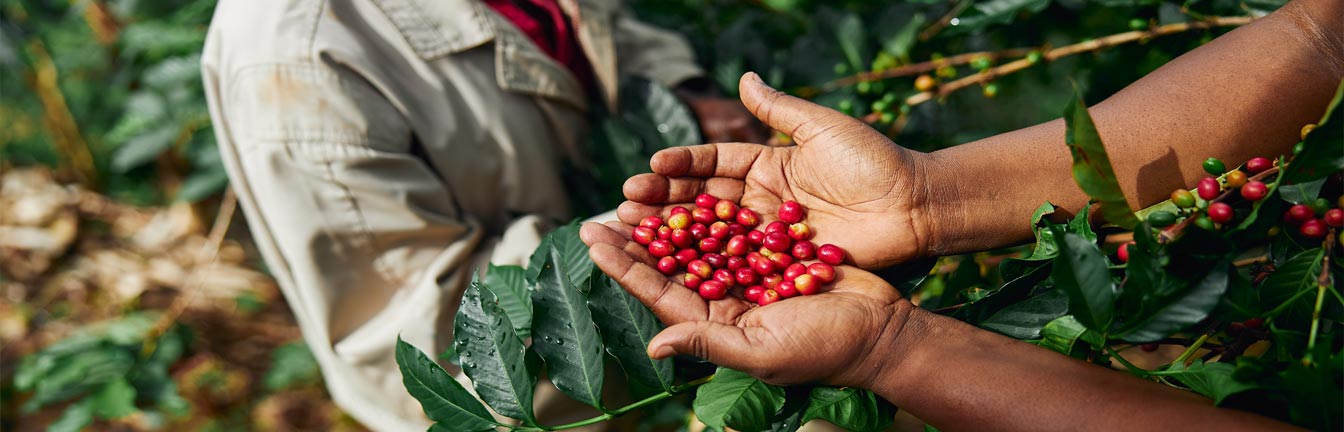
The client for this project was a national coffee company established to develop a fully integrated coffee industry, from farming and processing to roasting and retail. Its vision is to become one of the largest integrated coffee players globally and to put its home market on the global coffee map.
In this engagement, the client wanted to make sustainability a core part of its strategy and operations. It needed a sustainability strategy, a structure to deliver it, and practical action plans and budgets to put it into effect.
Problem
Coffee is one of the world’s most widely traded agricultural commodities, and one of the most exposed to climate change, water scarcity, and pressure on farmer livelihoods. Buyers, investors, and regulators increasingly expect producers to report on and reduce their environmental and social impacts, from carbon emissions and water use to fair treatment of farmers. The client is a case in point. It was building a coffee industry that relied on small farmers in the south of the country, where water supply and irrigation were key constraints, while seeking to grow into a global player. For the client, these trends presented both an opportunity and a challenge.
Despite its commitment, the client’s sustainability efforts were at an early stage. A gap analysis showed that strategy was not cascaded through the organisation, projects lacked supporting initiatives, the project management office had a limited scope, and teams worked in silos with differing interpretations of what sustainability meant. The client needed to prioritise the issues that mattered most, decide how sustainability should be organised, and translate its ambitions into funded, scheduled initiatives. Without this, it risked a strategy that existed on paper but not in practice.
Solution
Farrelly Mitchell was engaged to develop and operationalise a sustainability strategy for the client. To tell the company where to start, who should lead and what each step would cost, we:
- Prioritised material issues with stakeholders and management.
- Ran a gap analysis and defined a change agenda.
- Reviewed best practice in agrifood sustainability.
- Designed the sustainability strategy framework and objectives.
- Compared centralised, decentralised, and distributed structural models.
- Assessed human capital maturity across the organisation.
- Developed action plans for 19 initiatives over 24 months.
- Designed the operating budget for each initiative.
Impact
The sustainability strategy delivered by Farrelly Mitchell gave the client a clear set of priorities, a structure to deliver them, and a funded plan of action.
The materiality assessment prioritised the issues of greatest importance to stakeholders and the business, including water supply infrastructure, employee health and safety, farmer support, supply chain management and traceability, ethical business practices, waste management, community impact, certification, and renewable energy. A change agenda, built on the gap analysis, set out the people, process, and technology changes needed.
The business model design compared structural options and recommended starting with a centralised sustainability model, which would be easier to resource and establish, before moving towards a decentralised model over several years. A human capital maturity assessment identified the organisational development and talent priorities needed to support it.
The operationalisation and budget workstreams turned the strategy into 19 initiatives over 24 months, each with an action plan and budget. They ranged from sustainability reporting to GRI standards, a roadmap for reducing scope 1, 2, and 3 emissions, and the integration of climate and nature-related disclosures, to Rainforest Alliance accreditation, smart farming, irrigation water deficit reduction, an agroforestry pilot, composting and wastewater treatment, training and a support scheme for coffee farmers, and a supply planning office.
Forge ahead with Farrelly Mitchell
Altogether, the engagement equipped the client to embed sustainability across its coffee value chain, offering a blueprint for agrifood companies seeking to turn sustainability ambitions into action and showing how the rigorous, data-driven advisory we deliver at Farrelly Mitchell supports high-value sustainability and investment decisions. Our global presence and deep local market expertise enable us to provide insights that go beyond surface-level market overviews to deliver genuinely actionable strategic guidance.
Our comprehensive suite of advisory services includes sustainability strategy, ESG advisory, operating model design, organisational development, and implementation planning. To explore how Farrelly Mitchell can support your organisation’s strategic objectives in food and agriculture, wherever you operate, contact our team today.

