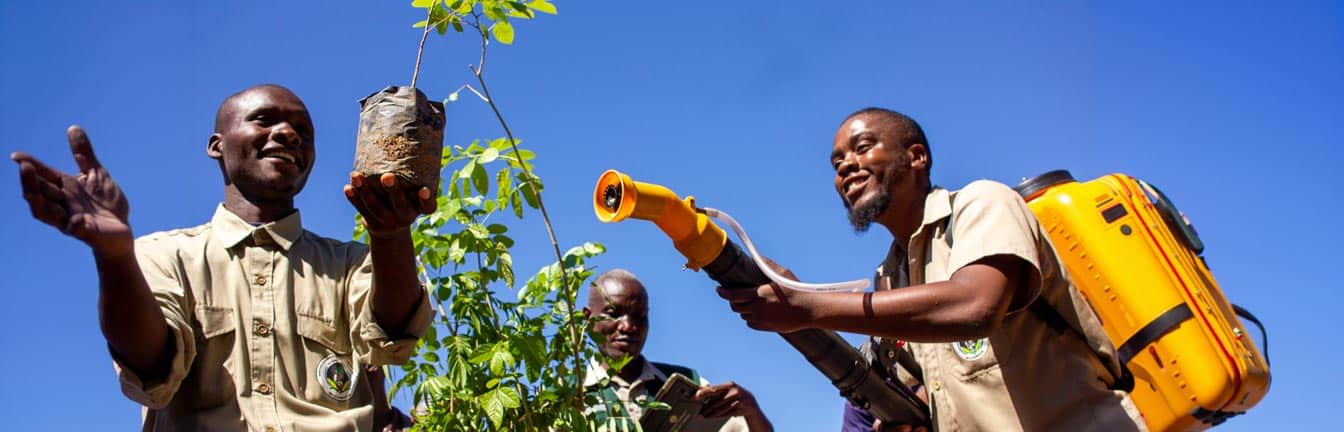
Agroforestry in Africa can raise crop yields without causing the decline in soil, water, and erosion benefits that usually accrue when farms intensify, that is according to a meta-analysis by Shem Kuyah and colleagues published in Agronomy for Sustainable Development. Drawing on 1,106 paired observations from 126 peer-reviewed studies across the region, the authors present what they describe as the first regional synthesis to show that agroforestry in Africa delivers mutual gains rather than the trade-off that agricultural intensification usually forces.
Mutual benefits
Intensive farming produces more food but often erodes the regulating services that sustain production over time, such as soil fertility and water retention. The study tests whether agroforestry, the deliberate growing of woody perennials alongside crops, can escape that bind and finds that it does. Across the studies reviewed, agroforestry improved the provisioning service of crop yield and the regulating services of soil fertility, while also reinforcing erosion control, and bolstering water regulation. The gains held across humid and semi-arid zones; highland and lowland sites; and both trees and shrubs, with no significant difference between most ecological or management categories.
Yields roughly double while soils stay fertile
The clearest result related to yields, which were almost twice as high under agroforestry as in tree-less controls, with about 70% observations showing an improvement. Soil fertility rose more modestly but consistently, by roughly 20% across total nitrogen, soil organic carbon, and available phosphorus. Soil organic carbon showed the strongest and most reliable gain among the fertility measures, which the authors attribute to carbon fixed by trees and returned to the soil through leaf and root decay. Available phosphorus improved the least, because trees recycle existing phosphorus rather than adding it, and recycling does not always release the nutrient in a form crops can take up.
Large gains for erosion and water
The biggest effects were recorded for erosion control and water. Agroforestry cuts runoff roughly fivefold and soil loss close to tenfold. It also lifted water infiltration nearly threefold, with a smaller gain in soil moisture. The authors are candid that these figures probably overstate the real effect. Their statistical tests pointed to publication bias for both erosion and water regulation, meaning studies that found little or no effect were less likely to have been published. They also note that most primary studies lacked the variance data a meta-analysis would normally use to weight results, so effects were weighted by sample size instead. So, while the direction of the benefit is likely accurate, the magnitude of that benefit should probably be treated as an upper bound.
Where trade-offs still appear
The benefits were also not universally realised. Yield gains coincided with improvements in nitrogen and soil organic carbon in roughly three cases out of four, but with available phosphorus in only about half. Trade-offs surfaced where trees competed with crops for water, nutrients, or light. For instance, unpruned trees transpired heavily and drew down soil moisture, with the resulting dense shade suppressing yields. Hedgerows were the one practice that reduced yields outright. The practical lesson the authors reach is that matching the right species to the site, choosing sound tree-crop combinations, and managing canopies through pruning can hold these trade-offs in check.
What this means for agriculture and agroforestry in Africa
For a region where smallholdings make up around four in five farms and roughly seven in ten people depend on agriculture, the findings are significant. Across parts of Africa, soils are at risk of losing their productive capacity, and many farmers cannot readily buy their way to higher output through fertiliser or irrigation. Agroforestry in Africa offers a low-input route to higher yields that also rebuilds soil, steadies water supply, and curbs erosion, strengthening both food security and resilience to environmental shocks. The authors stop short of treating it as a guaranteed fix, noting that the durability of these benefits under a changing climate still needs to be established. Even so, the weight of evidence supports agroforestry as a sound foundation for sustainable intensification across the region.
At Farrelly Mitchell, our agroforestry consultants provide technical, strategic, and commercial expertise to help agribusiness owners, policymakers and NGOs make informed decisions, achieve sustainable growth and bolster regional food security. With a proven track record of agribusiness projects across Africa, our agroforestry and biodiversity experts help clients evaluate regenerative practices. We combine local market insights with a clear understanding of global best practices to design land-use strategies that lift yields, rebuild soil, and strengthen resilience to environmental shocks. Contact our experts today to discuss how we can support your organisation drive more productive and sustainable land use.