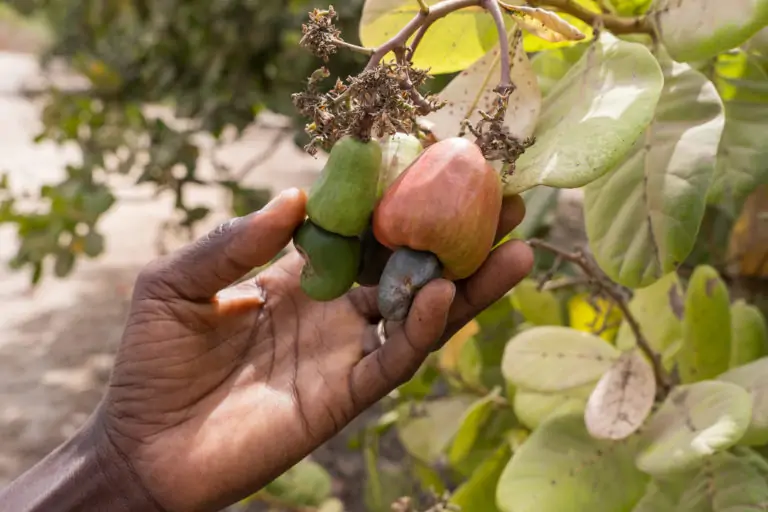
Africa is becoming increasingly important in raw cashew nut production where Nigeria, Tanzania, Mozambique, Côte d’Ivoire, and Guinea Bissau are the largest producers on the continent, while Ghana, Burkina Faso, and Benin are increasing their production year on year. Despite the fact that the worldwide cashew kernel market is steadily growing, it is dominated by a small number of traders.
Missed opportunities for the cashew nut
The lack of such desperately needed attempts to capitalize on the vast potential in West African cashew production leaves West African countries with a disappointingly low percentage of the total value they could attain by only focusing on two production stages of the value chain.
Roughly 90% of RCN produced in West Africa is directly exported and more value is added in Europe and North America, where 60% of traded kernels are roasted, salted, packaged, and consumed as a snack or an ingredient. This implies that West African countries are losing the potential benefits that could be reaped from value addition to the raw cashew nuts.
Some of the key challenges to growth include:
- Difficulty in accessing farm inputs and good planting materials
- High incidence of pest infestations.
- Inadequate extension services.
- High-interest rates and lack of working capital.
- Inconsistent supply of RCN to processing companies.
- Weak farmer associations.
- Inadequate transport facilities and frequent fluctuations in the price of fuel.
- Lack of an effective marketing information systems.
- Frequent bush fires.
Potential advantages of increased investment and growth in the cashew nut
Organic cashew kernels are rising at double-digit yearly rates in the United States and Europe, according to reports. Capitalising on this growth could bring exponential potential to West Africa such as:
- Employment opportunities
- Increase in export revenue and a resultant growth in GDP
- Economic specialisation
- Maximization of agricultural resources in West Africa
- Development in infrastructure
- Environmental impact: The shells make up 80% of the RCN, thus when local processing is increased, the effects on the environment due to the use of fossil fuels is reduced.
Cashew nut environmental considerations
Cashew has been found to be a valuable tropical cash and food tree crop that can grow on even marginal lands, it also has the ability to stabilise the soil that it grows on. The additional tree cover provided by cashew plantations helps to relieve the pressure on local vegetation and increases soil fertility.
As a result, the effects of drought and desertification are lessened. In addition, the use of cashew shells to fire boilers and ovens during processing reduces the need for cutting down trees for firewood, and hence reduces the pressure on surrounding forests. As with any other tree, cashew trees also act as carbon sinks, which means that they contribute positively to the growing threat of high carbon emissions.
Potential negative environmental impacts include loss of habitat and subsequent decrease in biodiversity as cashews would decrease the land and resources available for other plants and animals in the ecosystem.
Crop loss is also more likely due to increased susceptibility to pests and diseases. This is due to cashews’ high susceptibility to parasitic fungus, as well as other pathogens.
Summary
The findings of this report suggest that the opportunities for value chain expansion in West Africa are undercapitalized, with plentiful opportunities for growth. Policy action and investment support would ultimately lead to the improvement of livelihoods and generate income for African economies.
Learn more about Farrelly Mitchell’s food and beverage and agribusiness expertise in Strategy & execution, Capacity building and training, and Feasibility & financial modelling.