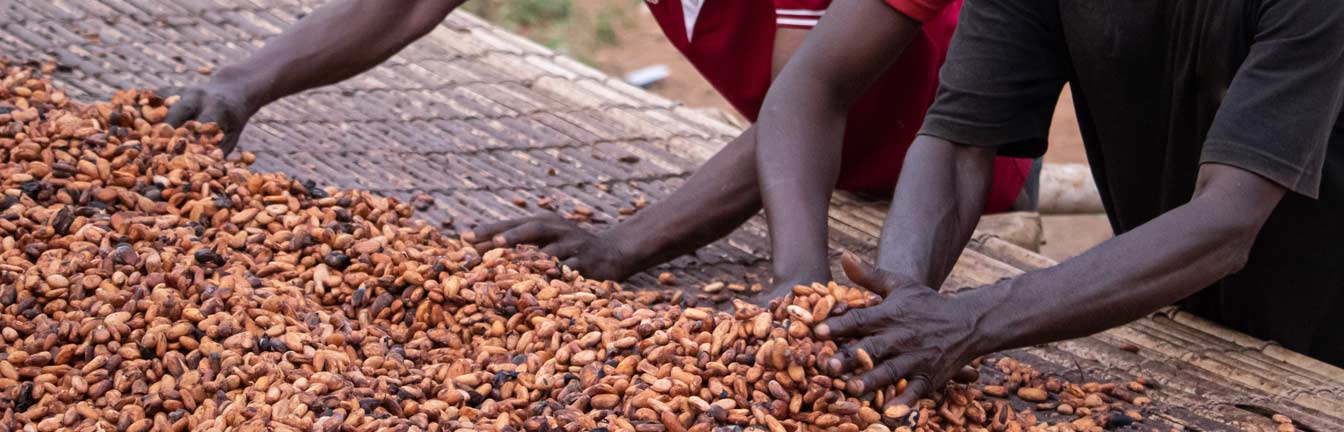
The majority of the world’s cocoa is exported by Ghana and Côte d’Ivoire but cocoa farmers in these regions earn significantly less than the living income. This threatens the viability of the supply chain. As a result, in 2019, the world’s leading cocoa producers Ghana and Côte d’Ivoire introduced the Living Income Differential (LID) to increase farmer earnings.
This article explores the challenges faced by farmers in Africa and how the LID is improving the incomes of smallholder farmers in Africa and impacting the future of cocoa prices.
Challenges faced by smallholder farmers in Africa
In Ghana, cocoa provides livelihoods for about a quarter of the population. After Côte d’Ivoire, Ghana is the second largest exporter of cocoa (the main ingredient in chocolate) and together both produce approximately 70% of the world’s cocoa. Small farms of between one and three hectares typically yield around 400kg to 500kg of cocoa per hectare. Despite their size, collectively these small farms are responsible for producing a large portion of the world’s cocoa supply.
In 2017, the Prince of Wales’ International Sustainability Unit organised the Cocoa and Forests Initiative, wherein Ghana and Côte d’Ivoire committed to addressing critical sustainability challenges such as child labour, illegal deforestation, and farmer poverty. As part of the initiative, both countries pledged to eliminate child labour and deforestation from their cocoa supply chains, meeting these goals would require significant change including raising the average cocoa farmer earnings.
In Africa cocoa producers’ average yearly family earnings are far lower than the predicted living income standards. The combination of rapidly increasing production and living expenses, along with low global market prices and stagnant farmer returns makes it very difficult for hundreds of thousands of smallholder farmers to break out of poverty. A typical cocoa smallholder household in Ghana and Côte d’Ivoire only makes 42%-50% of the income needed to cover basic expenses.
Furthermore, the challenges faced by smallholder farmers in Africa can negatively affect both the environment and the people involved, with farmers frequently clearing forests for agricultural purposes and relying on labour from their immediate family. It is believed that more than 30% of children in West Africa are engaged in cocoa growing, which often requires them to engage in dangerous work and prevents them from attending school.
Moreover, with average yields from exiting land frequently stagnating or declining owing to lack of capital, aged trees, and insufficient agri inputs. Consequently, growers are often compelled to unlawfully extend their production into gazetted forest areas in order to sustain production. Presently, around a third of the cocoa crop in Ghana and Côte d’Ivoire is grown with some level of encroachment into protected forests. This not only exacerbates deforestation but also threatens the long-term sustainability of cocoa farming, as growers struggle to invest in productivity-enhancing practices and more climate-resilient techniques. Without meaningful interventions, these issues will continue to undermine both the environment and the livelihoods of smallholder farmers.
Reducing the challenges faced by smallholder farmers in Africa
In 2019, realising that they could no longer afford to ignore pressing social and environmental problems and wait for a market shift to cause global prices to rise, Ghana and Côte d’Ivoire introduced the LID. LID aimed to increase cocoa farm-gate prices and by an additional $400 per tonne. This export pricing system, would significantly lift household earnings by sending price premiums down the supply chain to the level of the farmers.
Additionally, both countries intended to use the funds generated from LID to boost cocoa farming productivity. By co-investing in productivity growth projects, the two countries sought to help smallholder farmers increase their yields sustainably. These projects would involve collaborative efforts to provide farmer groups with access to agri inputs such as seeds and fertilisers as well as providing additional training, often on credit.
As part of this initiative, companies could also perform detailed tracking and audits at a farm level. This would involve tracing the operations of a sample of farms and conducting surveys to gather data on the prices cocoa farmers received. By doing so, companies could monitor whether the LID premiums were reaching the smallholder farmers.
LID’s impact and progress today
While the LID is certainly a positive step toward reducing poverty, it also faces significant challenges.
One of the major obstacles facing the LID is how its funds are distributed. LID does not address the structural challenges within the cocoa sector, such as land tenure issues, nor does it differentiate between farmers. This means that sharecroppers, caretakers, or those without tenure rights may not receive the same benefit as land owners. Consequently, farmers often report that the price premiums are not reaching them in full, and have raised concerns about inefficiencies within the system.
LID’s effectiveness is also limited by market dynamics. In some cases, buyers have sought cheaper sources of cocoa from non-LID countries. This reduces the demand for cocoa from Ghana and Côte d’Ivoire and weakens LID’s ability to improve the livelihoods of smallholder farmers.
Some have also argued that the scheme may have unintentionally exacerbated some issues. By raising the price of cocoa, LID has encouraged increased production, which can in turn lead to further deforestation as farmers seek to expand their cocoa farms into protected areas.
The future of smallholder farming in Africa
The challenges faced by smallholder farmers in Africa are complex and do not have a simple or immediate solution. Overcoming these issues will require a collaborative effort from government, development agencies, financial institutions, and the private sector. It will also require a combination of approaches and technologies.
Farrelly Mitchell is dedicated to helping smallholder farmers improve their productivity and farm operations by providing the necessary training, infrastructure, and information. We have decades of experience supporting developmental projects throughout the Global South. From our dedicated regional offices in Ghana and Kenya we provide a range of services tailored to the African market. Our services include institutional development, capacity building, food security consulting, programme design, and much more, contact our team today to find out more.